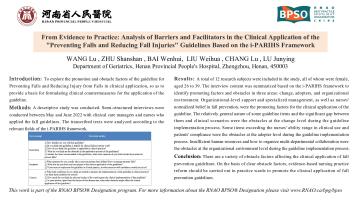
Understanding the facilitators or barriers to the clinical implementation of fall guidelines as perceived by participants can help researchers develop more effective intervention measures and promote the implementation and maintenance of more fall prevention measures. Therefore, the purpose of this study is to explore the barriers and facilitators to the implementation of fall guidelines at the levels of innovation, recipient, and context as perceived by participants.
Introduction: To explore the promotion and obstacle factors of the guideline for Preventing Falls and Reducing Injury from Falls in clinical application, so as to provide a basis for formulating clinical countermeasures for the application of the guideline.
Methods: A descriptive study was conducted. Semi-structured interviews were conducted between May and June 2022 with clinical care managers and nurses who applied the fall guidelines. The transcribed texts were analyzed according to the relevant fields of the i-PARIHS framework.
Results: A total of 12 research subjects were included in the study, all of whom were female, aged 26 to 39. The interview content was summarized based on the i-PARIHS framework to identify promoting factors and obstacles in three areas: change, adopters, and organizational environment. Organizational-level support and specialized management, as well as nurses' normalized belief in fall prevention, were the promoting factors for the clinical application of the guideline. The relatively general nature of some guideline items and the significant gap between them and clinical scenarios were the obstacles at the change level during the guideline implementation process. Some items exceeding the nurses' ability range in clinical use and patients' compliance were the obstacles at the adopter level during the guideline implementation process. Insufficient human resources and how to organize multi-departmental collaboration were the obstacles at the organizational environment level during the guideline implementation process.
Conclusion: There are a variety of obstacle factors affecting the clinical application of fall prevention guidelines. On the basis of clear obstacle factors, evidence-based nursing practice reform should be carried out in practice wards to promote the clinical application of fall prevention guidelines.
| Attachment | Size |
|---|---|
| 王璐-老年医学科.pdf (340.09 KB) | 340.09 KB |