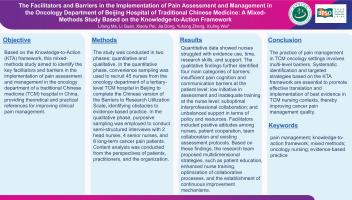
This mixed-methods study, guided by the Knowledge-to-Action framework, explored facilitators and barriers to pain assessment and management in the oncology department of a TCM hospital in Beijing. Quantitative results showed nurses faced challenges in evidence use, time, and support, while qualitative findings highlighted patient cognition, nurse training, interprofessional collaboration, and policy resources as key issues. Facilitators included positive attitudes, patient cooperation, and existing protocols. Targeted strategies such as education, training, and system optimization were proposed to improve cancer pain management.
Objective
Based on the Knowledge-to-Action (KTA) framework, this mixed-methods study aimed to identify the key facilitators and barriers in the implementation of pain assessment and management in the oncology department of a traditional Chinese medicine (TCM) hospital in China, providing theoretical and practical references for improving clinical pain management.
Methods
The study was conducted in two phases: quantitative and qualitative. In the quantitative phase, convenience sampling was used to recruit 45 nurses from the oncology department of a tertiary-level TCM hospital in Beijing to complete the Chinese version of the Barriers to Research Utilization Scale, identifying obstacles to evidence-based practice. In the qualitative phase, purposive sampling was employed to conduct semi-structured interviews with 2 head nurses, 4 senior nurses, and 8 long-term cancer pain patients. Content analysis was conducted from the perspectives of patients, practitioners, and the organization.
Results
Quantitative data showed nurses struggled with evidence use, time, research skills, and support. The qualitative findings further identified four main categories of barriers: insufficient pain cognition and communication barriers at the patient level; low initiative in assessment and inadequate training at the nurse level; suboptimal interprofessional collaboration; and unbalanced support in terms of policy and resources. Facilitators included positive attitudes among nurses, patient cooperation, team collaboration and existing assessment protocols. Based on these findings, the research team proposed multidimensional strategies, such as patient education, enhanced nurse training, optimization of collaborative processes, and the establishment of continuous improvement mechanisms.
Conclusion
The practice of pain management in TCM oncology settings involves multi-level barriers. Systematic identification and targeted strategies based on the KTA framework are essential to promote effective translation and implementation of best evidence in TCM nursing contexts, thereby improving cancer pain management quality.
| Attachment | Size |
|---|---|
| ID7-首都医科大学附属北京中医医院-马丽芳-壁报.pdf (433.62 KB) | 433.62 KB |